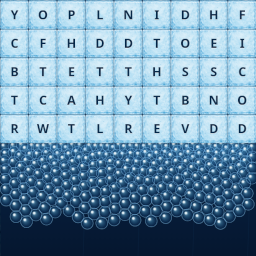
It looks like Tetris. It is the opposite of Tetris in every way that turned out to matter.
Wordfall drops lettered blocks into a grid seven columns wide and twelve tall — a tall, narrow field, roughly
the shape of the phone it is played on. You spell words by tapping adjacent letters — sideways, up and down,
or diagonally — and tapping the last one again submits. The letters you used vanish, everything above them
falls into the gap, and the pile settles. Ten words takes you up a level. Let the pile reach the top of any column
and it is over.
So far, so familiar. Then almost every instinct borrowed from the falling-block genre turns out to be wrong here.
You do not get to place anything
This is the big one. In Tetris the entire skill is deciding where the piece goes; the game gives you a shape and asks
you to find it a home.
Wordfall takes that away completely. A new block does not arrive where you want it. It lands above whichever column
is currently shortest, with ties broken at random, and you have no say at all. There is no rotate, no shift, no soft
drop. The pile builds itself.
That sounds like removing the game, and it is the thing that makes the game work. The skill here is not construction,
it is reading — finding words in an arrangement you did not choose and cannot influence. Giving the
player placement control would have split their attention between two completely different problems, and the
arrangement one is easier, so it would have won.
The shortest-column rule is also doing quiet structural work. Because every block lands on the current low point, the
surface stays roughly level instead of growing towers and canyons. A flat pile is a dense pile, and density is
adjacency, and adjacency is the only thing that makes words findable. A gravity rule that let the player stack
columns would produce boards that were technically full and practically unplayable.
The narrowness of the field pulls the same way. Seven columns means no letter is ever far from any other, so a word
rarely has to travel — which matters enormously on a screen you are reading with one thumb. A wider grid would
look more generous and be harder to find anything in, because the letters you needed would keep turning out to be
four columns apart.
An empty board is not safety
Here is the inversion I did not see coming, and it took a real fix.
In every other falling-block game, clearing space is the goal and a nearly empty board is the safest state you can be
in. In Wordfall it is close to a losing position. Letters are only usable if they touch each other, so a sparse grid
is one with nothing to spell — a handful of isolated blocks sitting on the floor with no neighbours, and you
cannot do anything except wait for more to fall.
Playing well produced boredom. Clear efficiently for a minute and you would be rewarded with a nearly empty grid and
a long wait, which is exactly backwards.
The fix is a rule that would be absurd in any other game of this shape: when the grid drops below about two rows'
worth of blocks, the drop rate triples until it is rebuilt. The game accelerates to help you. It is gated
to the early levels, because from level five onward the base rate is quick enough that the board refills on its own.
It is also why the board does not start empty. Two rows are already there at the bottom when you begin, so the first
thing you see is something you can play rather than something you have to wait for.
The difficulty curve was a divide
The first speed formula was the obvious one: take the base interval and divide it by the level. Eight and a half
seconds at level one, four and a quarter at two, and so on.
Two things were wrong with it. The first is that it collapses far too quickly — by level five you are at 1.7
seconds, which does not leave enough time to read a board, let alone spell from it, and a game that ends at level
six is not a game with ten levels in it.
The second is more specific and more interesting: the fall animation takes almost four seconds. Once the drop
interval dropped below that, blocks were being spawned before the previous one had landed, and they overlapped in
mid-air. The difficulty curve had quietly walked into the renderer.
The replacement grows the divisor linearly instead: eight and a half seconds at level one, a little over three at
level five, about two at level ten. The same destination, reached over twice as many levels, and the interval stays
above the animation for the part of the curve where anyone is still reading carefully.
Tuning constants like these are the part of a game that looks least like design and is most of it. The mechanic was
finished weeks before the game was any good.
A way out of a dead board
Random letters weighted by English frequency will still, occasionally, hand you a corner of the grid that is all
consonants, or a board where nothing touches anything useful. Left alone, that is a slow loss you can see coming and
do nothing about, which is the least interesting way for a game to end.
So a small proportion of blocks — roughly one in thirty — arrive as shuffle blocks. When one lands, every
letter on the board is redistributed. Same blocks, same shape, completely new arrangement.
The rate took some finding. It started around one in ten, which was far too generous: a rescue that arrives every
twenty seconds is not a rescue, it is a mechanic, and it taught players to wait for it rather than work. At one in
thirty it is genuinely lucky when one shows up, which is the correct feeling for a get-out-of-jail card.
Long words, disproportionately
A word scores its length squared, times ten, times the current level. Minimum three letters.
Squaring rather than multiplying is the whole scoring design. Linear scoring makes two three-letter words exactly as
good as one six-letter word, and since short words are much easier to spot, a rational player would never look for
anything longer. Squared, a six-letter word is worth four three-letter words, and the board suddenly rewards the
thing that is actually hard: holding a long chain in your head while you check that each next letter is adjacent to
the last.
It also plays against the emptiness problem. A long word removes a lot of blocks at once, so the big scoring play is
also the one that risks stranding you — which is a tension worth having rather than a flaw.
Whose dictionary
The word list is an external file loaded at runtime rather than compiled in: around 5,800 common English words, three
letters or more, nothing hyphenated. Keeping it outside the code means it can be swapped without touching the game,
and the game supports more than one — configure a second list and the player is asked once which they would
like, and the choice is remembered.
That matters more than it sounds. The word list is the difficulty of a word game, far more than the drop
speed is. A list of 5,800 common words and a full tournament dictionary produce two different games on identical
boards: one where you lose because you could not see the word, and one where you lose because you did not know it.
Those are not the same experience and players do not want the same one.
Everything else is seeded, which means a board is reproducible from a number — the same seed deals the same
game, which is what a shared daily challenge would need if it ever grew one.
What it taught me
Borrowing a shape from a familiar genre gets a player oriented in about four seconds, which is worth a great deal.
The cost is that you inherit the genre's assumptions along with its silhouette, and some of them will be wrong for
the game you are actually making.
Here, two of the biggest were: that the player should control placement, and that clearing space is progress. Both
are true in the game this one resembles. Both are false in this one, and neither of them announced itself —
the first was simply never considered, and the second showed up disguised as the game getting boring when I played
it well.