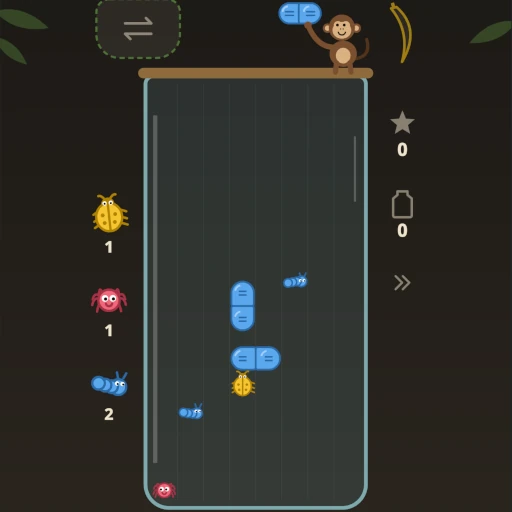
T2K is inspired by 2048 and Tetris.
This is a Cheery Chimp original.

T2K is inspired by 2048 and Tetris.
This is a Cheery Chimp original.
Feel free to contact us with any bugs, complaints, or requests.
The 2048 puzzle game was created in 2014 by Gabriele Cirulli, a 19-year-old Italian developer. He built the game as a weekend project inspired by earlier number-merging games such as 1024! and Threes!. The objective was simple: slide numbered tiles across a grid, combining matching values until reaching the 2048 tile.
Because Cirulli released the game free and open-source on the web, it spread rapidly through social media and word of mouth. Millions of people played it within weeks, and countless variations soon appeared, featuring different board sizes, themes, and gameplay mechanics.
Today, 2048 is considered one of the most influential casual puzzle games ever made. Its simple rules, strategic depth, and accessibility helped inspire an entire genre of merge-style and number-combination games that remain popular on mobile devices and websites around the world.
Tetris was born at the Soviet Academy of Sciences in Moscow. In 1984, a software engineer named Alexey Pajitnov was tasked with testing a new Soviet computer system, the Elektronika 60. To see what the machine could do, he decided to program a game based on a childhood favorite: pentominoes (puzzle pieces made of five squares).
Realizing that twelve different five-square combinations were too complicated, Pajitnov scaled the pieces down to four squares—creating tetrominoes. Because the primitive Elektronika 60 could only display green text, the original "blocks" were actually built out of bracket symbols [ ]. He named his creation Tetris, blending tetra (the Greek prefix for four) and tennis (his favorite sport).
The game was so addictive that Pajitnov and his colleagues couldn't stop playing it. Soon, a 16-year-old student named Vadim Gerasimov ported the game to IBM PCs, allowing it to spread throughout the Soviet bloc via floppy disks.
By 1986, a copy made its way to Hungary, where a Western software salesman named Robert Stein spotted it. Sensing a goldmine, Stein attempted to secure the rights to sell it in the West. However, because Pajitnov had created the game while working for the Soviet government, the state owned the rights under communist law. A Soviet agency named ELORG (Electronorgtechnica) was set up to handle the negotiations.
What followed was a dizzying, multi-party legal battle throughout the late 1980s involving British media moguls, American publishers, and Nintendo. Companies sold rights they didn't actually own, and contracts were signed under intense Soviet scrutiny.