This app supports enhanced storage and sync with a Google Account login. Login is optional.
MathShot
Clear your queue of balls by matching the target number shown on screen.
This is a Cheery Chimp original.
How To Play MathShot
The Basics
Each level gives you a queue of numbered balls to shoot. The board holds concentric rings filled with numbered balls. A target is displayed in the center — your job is to shoot a ball so it lands next to a ring ball and the two numbers hit the target together.
-
Aim by dragging or moving your finger/cursor across the screen
-
Shoot by tapping or clicking
-
If the two balls match the target, they pop and score points
-
If they don't match, the ball stays in the ring and you lose a life
Operators
Each level uses one math operation: addition, multiplication, subtraction, and powers.
The Queue
The next several balls are shown in an arc to the upper-left. The front ball is in the center hub ready to shoot. After you shoot, the next ball slides in automatically. If you wait too long, the ball fires on its own.
Tips
-
Red balls glow briefly to hint at a good target when you miss
-
Combos build if you match multiple targets in a row — points multiply
-
Later levels have a mastery gate: you must demonstrate enough skill at earlier operators before they unlock
-
The Double Up level is special — every ball you shoot is a 2, and the ring holds exponents. Shoot the 2 next to a 10 to hit 1024.
- Contact
Feel free to contact us with any bugs, complaints, or requests.
- Release Date
- March 13, 2026
- Last Update Date
- September 17, 2026
Behind the Scenes
Most maths games are a worksheet with a game bolted to the end of it. The whole point of this one was to put the arithmetic inside the aiming.
MathShot is a shooter. Numbered balls sit in concentric rings, you have a numbered ball to fire, and there is a target number displayed. Land your ball next to one whose value combines with yours to reach the target, and the pair pops.
That is the entire rule, and almost every decision in the game came from protecting it.
The quiz-with-a-reward problem
Educational games have a default shape, and it is worth naming because it is so easy to fall into. The game asks a question. You answer it. If you are right, something fun happens — a coin, an explosion, a turn at the actual game. Then it asks another question.
The trouble is that this arrangement teaches exactly what it looks like it teaches: that the maths is the toll and the game is the destination. The two halves sit in separate rooms. A child who has worked out that answering quickly gets them back to the fun part has learned something, and it is not arithmetic.
The alternative is for the sum to be the move. In MathShot nobody ever asks you what seven plus five is. You are looking at a board holding a five, an eight and a three, you have a seven in the cannon, the target says twelve, and you are deciding where to put it. The arithmetic happens because it is the only way to answer the question you actually care about, which is where to shoot. There is no reward for doing the sum, because doing the sum is the game.
Swapping color for a calculation
The skeleton here is the familiar one: fire a ball into a cluster, make a match, the match clears. What changes is the matching rule, and changing it alters the whole texture of the game.
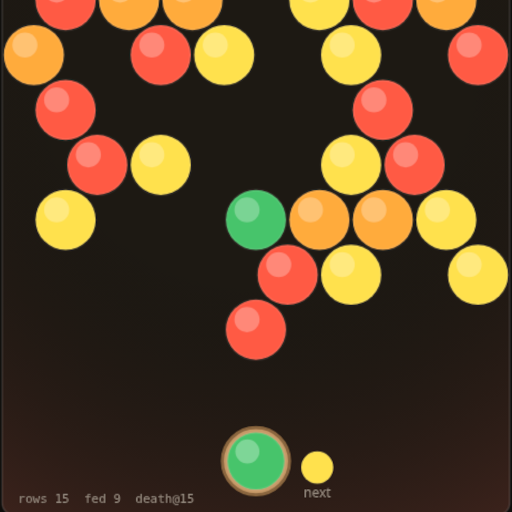
In an ordinary bubble shooter, matching is perceptual. Two reds are the same color and you know it before you have consciously looked — your eye does the work, and the difficulty lives entirely in the aiming. That is why those games can be played at speed and nearly in a trance.
Replace color with "these two reach the target" and the same geometry demands something else. Every candidate landing spot now needs evaluating, and you cannot evaluate it by looking. The board stops being a picture and becomes a set of small problems, one per neighbour. It slows the game down, on purpose — and the slowing down is where the practice is.
The other consequence is quieter. Because the ball you are holding pairs differently with every ball on the board, one number is not simply better than another. A seven is brilliant next to a five and useless next to a two, and that changes as the board changes. The value of what you are holding depends on where everything else is, which is a more interesting thing to think about than whether you can hit a gap.
The ladder of operators
Levels move through addition, then multiplication, then subtraction, then negative integers, then powers of two and exponents.
The last two are the ones the shooting format earns its place on. Negative numbers are hard to teach partly because they break an intuition built up over years of addition: that combining two things makes a bigger thing. Written down as a line of symbols, that is an abstract violation. Fired into a board where the target is four and the only route to it is a nine and a minus five sitting next to each other, it is a thing you watch happen. Same with powers — the point of exponents is how fast they grow, and a ladder of balls where each is double the last shows the growth as a physical fact about the board rather than a claim in a textbook.
Passing a level is not knowing the thing
The part I would keep if I had to throw the rest away is not in the shooting at all.
A level score tells you almost nothing about what a player knows. Someone can clear a multiplication level comfortably while still being shaky on seven times eight, because they dodged it — there were other pairs available, and people route around the facts they are unsure of without noticing they are doing it. Aggregate success hides specific ignorance, and the more options a level offers, the better it hides it.
So the game tracks every individual fact, hit and miss, separately. Not "how is this player doing at multiplication" but "how is this player doing at this particular sum". And the later operators are gated on mastery of the earlier ones — not on having finished those levels, but on the facts underneath them actually being known.
That gate is the one design decision I remain slightly uneasy about. Blocking progress is a real cost: a player who wants to see the next thing and cannot is a player who may close the tab. The argument for it is that the alternative is worse — handing someone exponents while their times tables are still guesswork produces a very specific kind of demoralisation, the sort where a learner concludes they are bad at maths when what actually happened is that they were let past a step. I would rather hold someone at a door than let them into a room they cannot stand up in.
Not my buttons
One last thing, which is about the site rather than the game. MathShot has no mute button and no pause button, because those live in the header of the page around it, and the game listens for them.
It sounds like housekeeping, but for a game aimed at children it is more than that. A parent looking for the mute should find it in the same place on every game here, not hunt for a different icon in a different corner each time. The controls that belong to the site stay with the site.