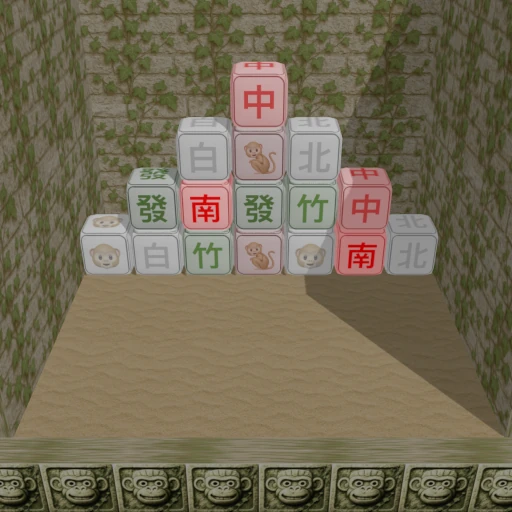
Although it uses traditional Mahjong tiles, Mahjong Solitaire is not the same as the classic four-player Chinese
game. Instead, it is a single-player puzzle that challenges players to remove matching pairs of tiles from a layered
arrangement. The four-player game is about drawing, discarding and racing three opponents to a complete hand. The
solitaire version keeps only the tiles and the idea of matching, and replaces everything else with a question of
order: which pair can be taken now, and what does taking it uncover.
The tiles are old. The puzzle is not.
The confusion is understandable, because the two halves of the game come from very different places.
The tiles are genuinely historical. Mahjong emerged in nineteenth-century China and its set of 144 pieces — the
three numbered suits of bamboo, characters and circles, plus the winds, the dragons, and the flower and season tiles
— had settled into something close to its modern form well before it reached the West in the 1920s. Anyone who
has played the four-player game will recognise every tile on the board here.
The puzzle laid out with them is barely forty years old, and it was made on a computer. In 1981 an American
programmer named Brodie Lockard built a tile-matching solitaire on PLATO, the pioneering educational computer
network, and called it simply Mah-Jongg. It ran on a CDC-721 terminal with a touch screen — a
remarkable thing to be writing a game for in 1981, and one that suited a game whose only verb is "tap that tile, and
that one".
How it came to be written
Lockard's own story is part of the game's history and rarely told alongside it. In December 1979 he was injured
dismounting from a trampoline while a student at Stanford, and woke in hospital paralysed and on a ventilator.
During a long rehabilitation he learned to type using a mouth-stick, and Control Data Corporation — the
company behind PLATO — arranged for a terminal to be brought to him.
The game that became the most-played tile puzzle in the world was written on that terminal, by someone operating it a
keystroke at a time. It is worth remembering when the board takes a few minutes to clear.
Shanghai, and a myth that stuck
Mahjong Solitaire reached the wider world in 1986, when Activision released a version called Shanghai for
the IBM PC, the Commodore Amiga, the Macintosh, the Atari ST and the Apple IIgs. It was a substantial hit —
figures of around ten million copies are commonly cited across its many versions and ports — and for a
generation of home computer owners, Shanghai simply was Mahjong.
Activision also marketed it as being based on a centuries-old Chinese game called "the Turtle". That claim has been
repeated ever since, in manuals, on packaging and on countless websites, and there is no evidence for it. Lockard
never made it himself. The turtle is the name of the default layout — the familiar four-layer pyramid with a
row trailing off each side — and it appears to have been invented along with the rest of the computer game.
The myth endures because it is a better story than the truth, and because the tiles genuinely are antique. But the
puzzle was designed in 1981 by one person, on a mainframe network, in a hospital bed.
Why it lasted
Today Mahjong Solitaire is available on nearly every platform there is, from desktop computers to smartphones and web
browsers. Hundreds of layouts, themes and rule variations have been created — spiders, bridges, dragons,
letters and numbers in place of tiles — but the core objective has never changed: clear the board by matching
free pairs, using careful planning rather than speed.
Its longevity is not an accident. The rules fit in a sentence, so nothing has to be taught. There is no opponent and
no clock, so nothing hurries you. And because a tile is only free when one of its long sides is clear, every pair
you take is a small decision about what you are willing to bury — which means a board that looks like a memory
test is actually a planning problem, and the same layout plays differently every time it is dealt.