The arithmetic is not the obstacle. The arithmetic is the drill, and there is something heavy
coming down while you use it.
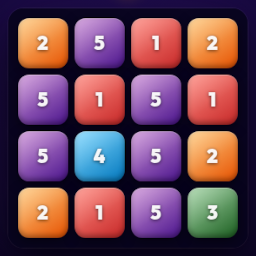
Lode Math is a wall of numbered blocks with balls resting on top of it and a crusher descending from above. You
select blocks that make the target — by adding or by multiplying — and the blocks you pick vanish. What is left is a
hole, and a hole is somewhere a ball can fall through to safety.
Every ball that gets out before the crusher arrives is saved. Every one that does not is not. When the round ends you
get one, two or three stars, and you can move on or try again.
Which means the sums are not a toll you pay for the fun part. The sum is the excavation. You are not
clearing blocks for points, you are cutting a shaft through a floor, and which shaft you cut is a spatial question
that happens to be answered with arithmetic.
A clock with a face
The crusher could have been a countdown. Thirty seconds on a timer would produce exactly the same pressure on paper,
and it would be much less effective.
A number counting down is information you have to read, convert and act on, and it is in the corner of the screen
rather than in the middle of the thing you are looking at. The crusher is in the playfield. It is the ceiling. You
do not read it, you see it, and every glance at the blocks you are working on includes it whether you meant to look
or not.
It also makes the danger local rather than global. A timer says "you have this long". A descending ceiling says "you
have this long here" — and the gap above the third column may be narrower than the gap above the first.
Where you choose to dig is a time calculation as well as a maths one, which is a lot to get from choosing a shape
over a number.
Adding or multiplying
The target can be reached by sum or by product, and having both available changes what the player is doing far more
than having either alone.
Addition is a scan: your eye runs over the block and looks for things that fit. Multiplication is a different search
entirely — factors, not neighbours — and a twelve that is impossible as a sum of the blocks in front of you may be
sitting right there as a three and a four.
That matters because of what the game actually wants from you. It is not asking "can you add up". It is asking "can
you find a route to twelve through this particular rubble", and a player with two methods has twice as many
places to look. For a child practising, the useful moment is the one where addition fails and they try the other
thing — which is the moment arithmetic stops being a procedure and starts being a tool you choose.
A target nobody could hit
The worst bug in the build was a target the board could not make.
It is easy to produce and hard to notice. Pick a target, the player clears some blocks, gravity drops the rest into
new positions — and now the set of reachable values is completely different from the set that existed when the
target was chosen. So the number at the top of the screen is one the player cannot make, they try every promising
combination, and they conclude either that they are bad at arithmetic or that the game is broken. One of those is
true.
The instinctive fix is to make the target-picking function smarter. That fix is wrong, and the reason is worth more
than the bug.
Targets get set from several places: when a level loads, when saved progress is restored, and after every clear when
gravity has finished settling. Fixing the picker means finding and fixing each of those, being right about all of
them, and then being right about every future path somebody adds that sets a target without thinking about this.
So instead of guarding the places where a target is chosen, the game guards the condition itself. Whenever
the grid or the target changes, it computes what is actually reachable on the live board — every adjacent sum, every
adjacent product — and if the current target is not among them, it quietly picks one that is. It also waits for any
animation to finish first, so it is never interrupting a clear mid-fall.
Nothing that sets a target has to remember to be careful, because being careful is no longer their job. That is the
difference between fixing a bug and removing the category it belongs to, and it is almost always worth the extra
half hour.
The bombs that were stealing stars
The other bug was quieter and, in its way, worse, because it did not break anything. It just made the player look
worse than they were.
Stars come from your save rate: how many balls got out, over how many there were. There are also bombs on the board —
hazards, not cargo, and nobody is trying to rescue them.
The count of what remained at the end was taken from the collection holding all the falling objects, and that
collection contains the bombs. So every bomb still sitting on the board at the end was counted as a ball you had
failed to save. The denominator was inflated, the save rate was deflated, and the stars came out lower than the
player had earned — consistently, invisibly, and always in the same direction.
A scoring bug that goes the player's way gets reported within a day. One that goes against them mostly does not; it
just feels slightly unfair in a way nobody can articulate, and the game is quietly harsher than it was designed to
be. Excluding the bombs from the count is a one-line fix and it is the kind of one-line fix I now go looking for
whenever a difficulty curve feels a bit meaner than intended.
Stars, and what they are measuring
Three stars, retry freely, progress on one.
The choice worth defending is what the stars are made of. They could have measured speed, or moves used, or raw
score. They measure the save rate — the proportion of balls that made it out — and that is the right one because it
is the only measure that is about the thing the player was actually trying to do.
Speed rewards the player who already knows their times tables and punishes the one who is learning them, which is
backwards in a game whose reason for existing is the second player. Move count rewards efficiency at the cost of the
safe, obvious route. The save rate says: you had these balls to rescue, here is how many you rescued. Nothing else
in the room is being graded.
And because one star is enough to move on, the game never blocks you at a level you have already demonstrated you can
beat. The other two stars are there for the second visit, which is exactly the visit where practice happens.
A name, and one word that kept its old meaning
This was called something else for a while — the working title described the crusher rather than the excavation,
which put the emphasis on the thing that beats you rather than the thing you do.
A lode is a seam of ore running through rock, worked by following it. That is a better description of the game: you
are not being crushed, you are getting something valuable out before the rock closes.
The rename touched a surprising number of places — a file, a component, a storage key, the title on the menu — and
one word deliberately survived it. When the crusher reaches the bottom the game still says CRUSHED,
because that word was never the name of the game. It was always a description of what just happened to you, and it
is still accurate.