Fruit Shuffle: a puzzle that goes around in circles
Most matching games let you move one piece at a time: swap two gems, drop a block, fire a bubble. Fruit Shuffle works differently. Every move slides a whole row or a whole column, and whatever falls off one edge comes back on the other. That idea has a history going back more than thirty years.
Yoshi's Cookie (1992)
The game that made the move famous is Yoshi's Cookie. Tose developed it and Nintendo published it for the NES and Game Boy, first in Japan in November 1992 and in North America the following April. A Super NES version came out in 1993, developed and published by Bullet-Proof Software, the company best known for bringing Tetris to Nintendo's consoles. Alexey Pajitnov, the creator of Tetris, is credited with designing that version's puzzles.
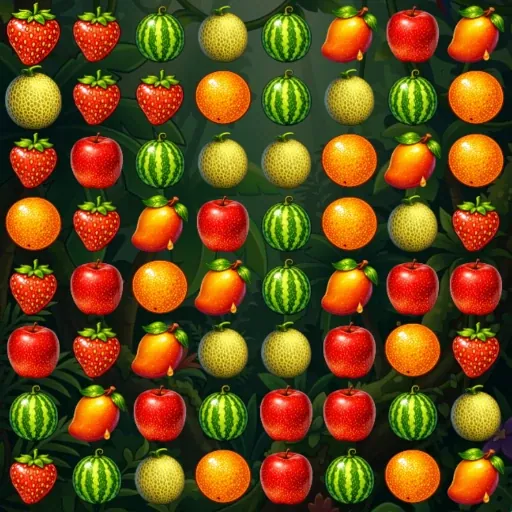
In Yoshi's Cookie the board is a grid of cookies. You slide rows and columns around, and when an entire row or column is a single kind of cookie, it clears. Special Yoshi cookies count as any kind. The SNES version added a versus mode against the computer and a puzzle mode, where you clear a fixed board in a limited number of moves.
The game took a winding road to get there. It reportedly began as an arcade game called Hermetica by the developer Home Data. When it tested poorly in arcades, the rights went to Bullet-Proof Software, which licensed the home versions to Nintendo.
Back for a second helping
In 2003 Yoshi's Cookie came back, rebuilt with new graphics, in Nintendo Puzzle Collection for the GameCube. That collection was only released in Japan, beside Dr. Mario and Panel de Pon. Its new version supported four players at once, a first for the game.
The slide-a-row family
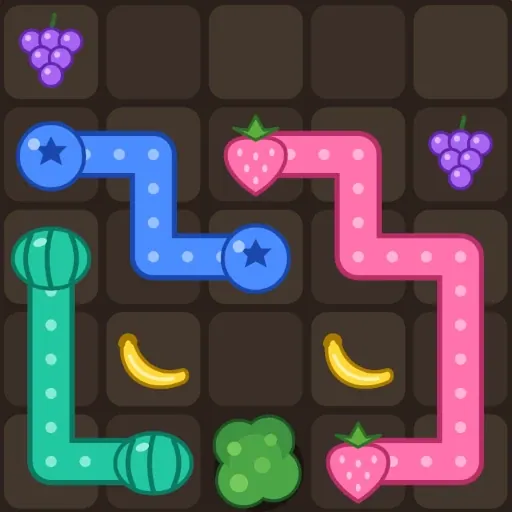
Sliding a whole line with wraparound turns up in other puzzles too. Mathematicians call a board that wraps on every edge a torus, shaped like a doughnut, and puzzle makers have played with it for years. A good example is Sixteen, from Simon Tatham's free Portable Puzzle Collection. It looks like the classic fifteen-tile sliding puzzle, but there's no gap: you shift whole rows and columns to put numbered tiles in order. Its sibling, Netslide, uses the same move to join pipes into one network.
These puzzles all share the same tension: every move helps one line and disturbs all the lines that cross it.
What Fruit Shuffle adds
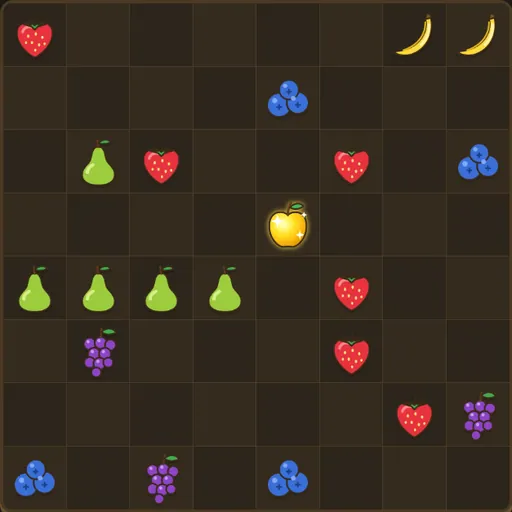
Fruit Shuffle keeps the heart of the old game, with whole lines of one fruit clearing, and puts its own spin on the rest:
- The board breathes. Every cleared line is removed and the board closes up, so it gets smaller and easier as you clear. New rows and columns grow back on the shorter side, and the game ends when there is no room left to grow.
- Chains. When the board closes up, a row that was one fruit away from matching can finish itself and clear too, for extra points.
- The diamond banana. Like the Yoshi cookie, it counts as any fruit, and a line with one in it scores double.
- Never stuck. If a small board is left with no possible way to make a line, it grows straight away instead of making you wait.
- Relaxed mode. No clock at all: the board only grows after you make a few moves that clear nothing.
Thirty years on, a simple slide is still one of the most satisfying moves in puzzle games. Go get your fruit in a row.