This app supports enhanced storage and sync with a Google Account login. Login is optional and free.
Your performance in this app contributes to your Mastery Report. You can view your progress and results anytime from your dashboard.

This app supports enhanced storage and sync with a Google Account login. Login is optional and free.
Your performance in this app contributes to your Mastery Report. You can view your progress and results anytime from your dashboard.
This is a Cheery Chimp original.
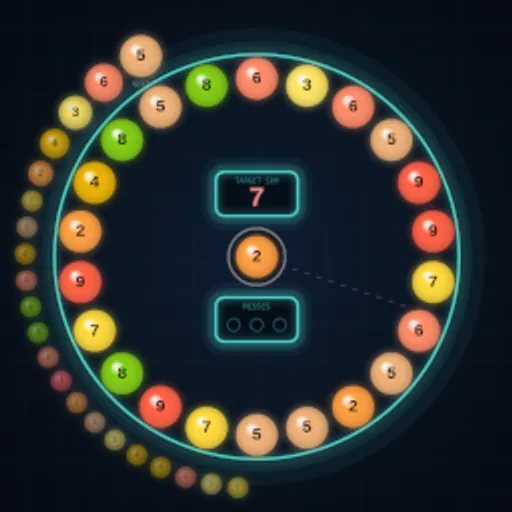
You start every level with four bubbles, each holding a 4. Squash them together, with the tools you've been given, into one bubble that shows the level's target number. Every 4 has to be used, and no other number is allowed in.
When you're one bubble away, the bubble wiggles. When it's right, it bursts into a pile of 1s, counted out into rows of ten.
Tap a bubble you've made and its last action undoes, with an animation that shows what it was made from. You can unpick a long chain one step at a time without starting the level again. The four starting bubbles each have their own colour until they're used, so you can follow where each 4 went.
Each group of levels introduces one new tool, so there's never a pile of unfamiliar buttons at once.
Every tool leaves its mark on the bubbles it makes: + and − as coloured wedges, × and ÷ as wedges with wiggly dividers, exponents as spikes, factorials as rings, and a swirl when a bubble has been through both kinds of operator. Subtraction and division add a wavy edge. The marks are decoration only, but they let you read a bubble's history at a glance.
Open the Sandbox from the ☰ menu. There's no level to follow: build any number you like with four 4s, and every whole number from 0 to 99 you make is added to your table. The box at the top counts how many you've found. Every tool is open, including the repeating decimal.
The game suggests a number to try next, picked to practise the ideas you've used least. Tap ↻ for a different one. If you're stuck on a suggestion, the hint button shows one step at a time. A number you make after a hint gets a 💡 in your table until you make it again without one.
Making a level's target in the Sandbox unlocks that level, so you can jump ahead in the campaign.
In the table, tap any number to see how you made it, and whether there's a shorter way. Numbers with a dashed outline need the repeating decimal. Some numbers have lots of answers and some have only a few strange ones. Part of the fun is finding a shorter solution when you already have one.
The campaign has 24 levels, four for each tool, ordered from gentler to trickier. The levels are chosen to show off what each tool can do, so some numbers are deliberately left out of the campaign. They're all still reachable in the Sandbox.
Every level has a par: the fewest steps it can be solved in. Each tool you use is a step, except adding bubbles that are side by side in the play area, which is free. Solving a level earns stars:
Stuck for a while? A hint button appears. Each hint shows one more step of a shortest solution and costs a star on that level, though a solved level always earns at least one. Your best result on each level is kept, so you can come back later and try for three stars without hints. The level list shows the stars you've earned.

It was 1988, I was in 9th grade, and my math teacher, Mr. Sullivan, handed me the Four Fours problem. He gave it to me and nobody else. The rules take ten seconds to say: using exactly four 4s, and any maths you like, make every whole number you can. I took the target numbers 0 to 100 and carried my progress around on a piece of paper, from class to class, for weeks. Every time a gap in the list got filled, it felt like winning.
I never finished. I didn't use decimals, which cut my toolbox down, and I'm certain I never found 73. I don't remember much else about those weeks, but I remember the paper, and the feeling that one more idea would crack the next number.
I can't remember the last time anyone gave me a puzzle like that. I suspect many modern students never meet it. It needs only a pencil, but it needs someone to put it in front of you, and for a lot of people that never happens. Mr. Sullivan did it for me, and this is my attempt to do it for you.
Four Fours is older than most people expect. A puzzle in this form was printed in 1881, in the magazine Knowledge, and by the time W. W. Rouse Ball wrote it up in the 1914 edition of his Mathematical Recreations and Essays he was calling it a "traditional recreation". Almost every version allows adding, subtracting, multiplying, dividing, brackets and sticking 4s together to make 44. Most also allow square roots, factorials, exponents and the decimal point.
Four Fours sneaks a lot of maths past you while you're busy chasing a number. Make 6 with 4 + (4 + 4) ÷ 4 and you've done real arithmetic in your head. Make 24 and you've met the factorial. Make 2 out of a single 4 and you've taken a square root, because you wanted to, not because a worksheet told you to. Brackets and order of operations stop being rules and start being tools you reach for. The game keeps track of the skills you practise, and the progress page on Cheery Chimp can show them to you.
A pencil-and-paper puzzle is a list. I wanted something that felt more like a toy. So the four 4s are squishy bubbles with weight. They drop into the play area, bounce, and squash against each other. When you push two together they merge with a pop and a gooey neck, and the new bubble holds the result.
I wanted to be able to tell what a bubble was made from at a glance, so each operator marks the bubbles it makes. Plus and minus are coloured wedges with straight dividers, times and divide have wiggly dividers, exponents are spikes, and factorials are rings. A bubble that has been through both families gets a swirl. The four starting bubbles each have their own colour, so you can follow where every 4 went.
The equation builds itself across the top with all the brackets in the right places, which turns out to be the best teacher in the game. You see the brackets appear, and you start to understand why they're there.
The obvious plan was a level for every number from 0 to 100, the list I chased in 1988. I decided against it. A hundred levels would turn a puzzle into a chore, and the same few tricks would come up again and again. Instead the campaign has 24 levels, four for each new tool: the basic four operations, joining 4s, decimals, square roots, factorials and exponents. Each level is chosen to show off what its tool can do. Some numbers are missing from the campaign on purpose.
But I know the itch. Some people won't be content until every number on the list is done, and for them there's Free play. Pick any target up to 99 and see what you can do, with every tool available, including one that has no levels at all: the repeating decimal, where .444… turns out to be exactly 4⁄9. If you're one of those people, this is your chance to finish the list I never did. I'll be looking for my 73 there too.
The best way to start is the way I did. Take a pencil and a scrap of paper, write the numbers 0 to 20 down the side, and see how many you can find with four 4s. You'll be surprised how far you get with only the basic operations and a little gluing of digits. Then come and play, and see how the tools change things.