Cheery Chimp

Chimp Pop

  • Home
  • About Us
  • Privacy Policy
  • Terms and Conditions
  • Contact Us

Chimp Pop

How To Play Chimp Pop

Chimp Pop is also known as Bubble Bobble, Bust-a-Move, Puzzle Bobble, and Snood.

Bubbles hang from the top of the board and creep downward. Clear them faster than they fall, and don't let them reach the bottom.

The goal

Chimp Pop is endless — there's no finish line, just a score. You survive as long as you can and rack up points along the way. It ends the moment a hanging bubble touches the shooter at the bottom.

Controls

Drag anywhere on the board to aim, then release to fire. A dotted line shows exactly where your bubble will go, bouncing off the side walls, and a ghost ring marks the spot it will land — what you see is what you get. The bubble you're about to fire sits on the shooter; the next one waits beside it, so you can plan two shots ahead. You can only aim upward, not sideways.

Making matches

Land a bubble against two or more of the same color and the whole group pops. Three is the minimum — the more you can set up at once, the better.

The big points come from cutting bubbles loose. Every bubble hangs from the top of the board, directly or through its neighbors. When a pop breaks the last link holding up a clump, that whole clump drops — and dropped clumps are worth far more than the pop itself. A bigger clump is worth much more than a small one, so the real skill is popping the one bubble that sends a huge chunk falling.

Bubbles that fall past the shooter on their way down are harmless. Only bubbles still attached to the top can end your run.

Keeping your streak

Pop something on every shot and a score multiplier climbs higher and higher. Miss even once and it resets to nothing — so a clean run of matches is worth chasing.

Every miss costs you twice

A shot that pops nothing doesn't just waste a turn. The bubble sticks where it lands, adding to the pile, and the entire board drops one row closer to the bottom. Missing is how you lose ground, so it's usually better to take a safe match than to gamble on a fancy one.

It gets harder

You start with three colors. As you go, more colors join in — up to six. More colors means matches are harder to find, misses come more often, and the board presses down faster. The shooter only ever hands you a color that's already on the board, so you're never stuck with a bubble you can't use.

Tips:

  • Aim for the bubble that drops the most, not just any match.
  • Bank shots off the walls to reach tight corners and overhangs.
  • When the board is getting low, prioritize clearing the lowest bubbles to buy room.
  • A long no-miss streak is often worth more than one lucky big drop — protect it.
Contact

Feel free to contact us with any bugs, complaints, or requests.

Release Date
August 15, 2026

History

Chimp Pop belongs to a family of games that traces back to a single arcade cabinet: Taito's Puzzle Bobble, released in 1994 and known in the West as Bust-a-Move. It borrowed its two dragon mascots, Bub and Bob, from Taito's earlier hit Bubble Bobble (1986), and around them built a puzzle that turned out to be almost perfectly shaped. A field of colored bubbles hangs from the top of the screen; you sit at the bottom with a launcher, aiming a single bubble upward and banking it off the walls; land three or more of a color together and they burst. The clever twist — the thing that gave the game its depth — was gravity by connection: pop the right bubble and any clump no longer attached to the ceiling comes crashing down all at once. That one rule is still the heart of the genre thirty years later.

Nearly every mechanic modern players expect was already there in 1994: the hexagonal, offset packing of the bubbles; the aim-and-bounce shot; the match-of-three; the falling of disconnected clusters; and the slow, menacing descent of the ceiling that ends your game if it reaches the bottom. Later designers added, tuned, and rebalanced, but rarely reinvented.

The format leapt off the arcade cabinet quickly. On home computers the standout was Snood (1996), a shareware game by David Dobson that became a fixture on college campuses and swapped the bubbles for a cast of little creature faces. In the open-source world, Frozen Bubble (2002) shipped on practically every Linux distribution and introduced the mechanic to a generation of tinkerers. And under the plain, generic name Bubble Shooter, countless browser and download versions kept the formula alive through the 2000s.

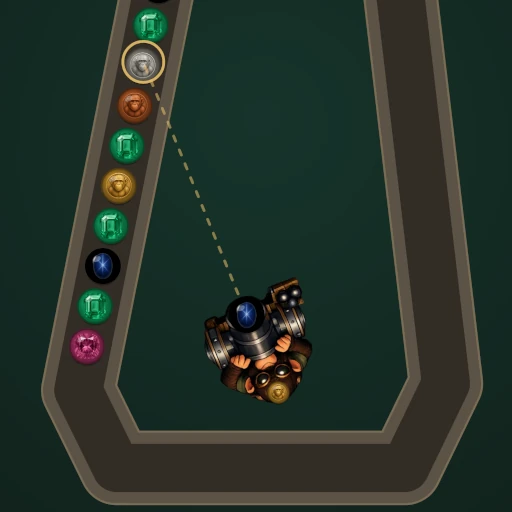
The genre's second life came with social and mobile gaming. King's Bubble Witch Saga (2011) wrapped the old arcade loop in a level-map "saga" structure, daily lives, and free-to-play hooks, and bubble shooters became a permanent fixture of app stores — endlessly cloned, reskinned, and reissued. It's worth noting a close cousin that is often confused with it: the marble popper (the Zuma and Luxor lineage, descended from Taito's Puzz Loop), where balls advance along a track and you shoot into a moving line. It shares the color-matching and the shooter, but it is a different game — the bubble shooter's defining feature is that static, hanging grid and the satisfying collapse when you cut it loose. Chimp Pop keeps to that classic line, with an endless, ever-descending twist.

icon for game Chimp Chain
Chimp Chain
icon for game MathShot
MathShot
icon for game Orbit 2048
Orbit 2048
  • About Us
  • Privacy Policy
  • Terms and Conditions
  • Contact Us

♻️ Made from 100% recycled electrons! ♻️

    Recently Played

      Games you open show up here.